Starting with the basics
What is soccer?
An essential question that seems silly but will be necessary to answer for the sake of this site. While it’s possible to delve into the details of this sport and its history, I’m going to take a more direct approach by explaining some of the rules and regulations. There’s a lot to cover so I’m going to split it up into multiple parts.
(By the way, if you’re looking into the history of soccer, I would check out The Ball is Round: A Global History of Soccer by David Goldblatt or The English Game, a Netflix original series. I haven’t been able to check these out yet but I hear they’re great [with The English Game being a little bit more dramatized and “made-for-TV”]).
The first step of becoming a soccer fan is having a good foundation. Seeing people score and make plays is great, but it’s essential to know about the gears that make the game run. That’s why the best video games start with tutorials and the best films start with expositions; to establish the basic rules of the world you are about to enter and give you a complete understanding of what’s to come.
Game Structure:
Soccer is a sport composed of two, 45-minute halves with a 15-minute break in between known as halftime. During the game itself, the clock never stops…even if a player gets injured and must be taken off. Instead, whatever time is used during these incidents (injuries, pause in play, etc.) is added on to the end of the half. This injury time can be as short as a minute or as long as five minutes. For example, if I were to pull a muscle in the first half and it takes trainers two minutes to take me off the field, then those two minutes would be added on at the end of that half. In that case, 45′ would become 45’+2.
Positions:
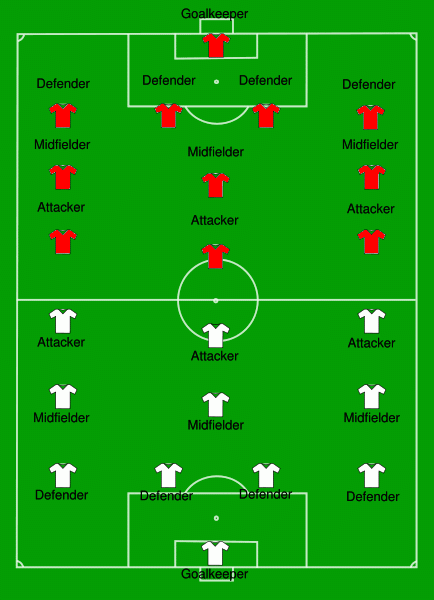
The goalkeeper is the person in charge of protecting the goal, making sure the other team doesn’t score. He is the only person allowed to use his hands to touch the ball, whether it be to make a save or to pass to a teammate. Defenders are positioned in front of the goalkeeper and move up with their team. While their main task is to defend against attacks, they can also start their own attacks and build momentum.
Midfielders roam the middle of the field, serving as the link between the defense and the attack. They do a variety of things, such as defend, attack, gain possession, etc.; their position requires a little bit of everything. Lastly, attackers play at the front and lead the attack against the opposing team. They carry most of the goal-scoring burden and can combine with each other and the midfielders. There are sub-positions among these general positions, but I will cover those in another post.
Team Structure:
Each team is allowed eleven players on the field at once. While they can only have one goalkeeper, the other positions are more fluid. For example, some teams only play with three defenders whilst others play with four or five. Some teams only play with three midfielders whilst others play with only two. These are all different types of formations that coaches can use to organize their team. Some formations are more popular than others.
Additionally, seven players are chosen to sit on the bench and are known as substitutes. For most games, coaches are allowed to make three substitutions for practical (a player gets injured) or tactical reasons. There are no guidelines for which players to have as substitutes, but there is always another goalkeeper to serve as backup just in case.
Winning the Game:
This one is fairly easy, although there are some exceptions. Whenever the ball goes into the net, it counts as a goal and whoever has more goals at the end of both halves wins. However, if both teams have the same amount of goals it ends in a draw. There are even some games where neither team scores a goal by the end of the game! These instances are draws as well.
The exceptions occur in special tournaments, games and competitions (all of which I will cover in the future). In these special occasions, a game will go into extra time if it is tied at the end of the first 90 minutes. There are two halves of extra time, each one being 15-minutes with the same injury-time rule. Even if a team scores in the first half, they will play out the rest of the extra time. If it is still tied after extra time, then the game moves to a penalty shootout to determine the winner. I will explain penalties later on.
I know it’s a lot to take in, but that’s why I’m splitting it up into multiple parts. For now though, that concludes Part 1. Thanks for reading and I hope you’ll stick around for part 2 coming soon!
 Four Score Soccer