Tim Howard. Tony Meola. Brad Friedel.
Three US goalkeeping legends who all made their impact on the program and led their respective teams in the FIFA World Cup. All three of them were top-choice players who played well and consistently.
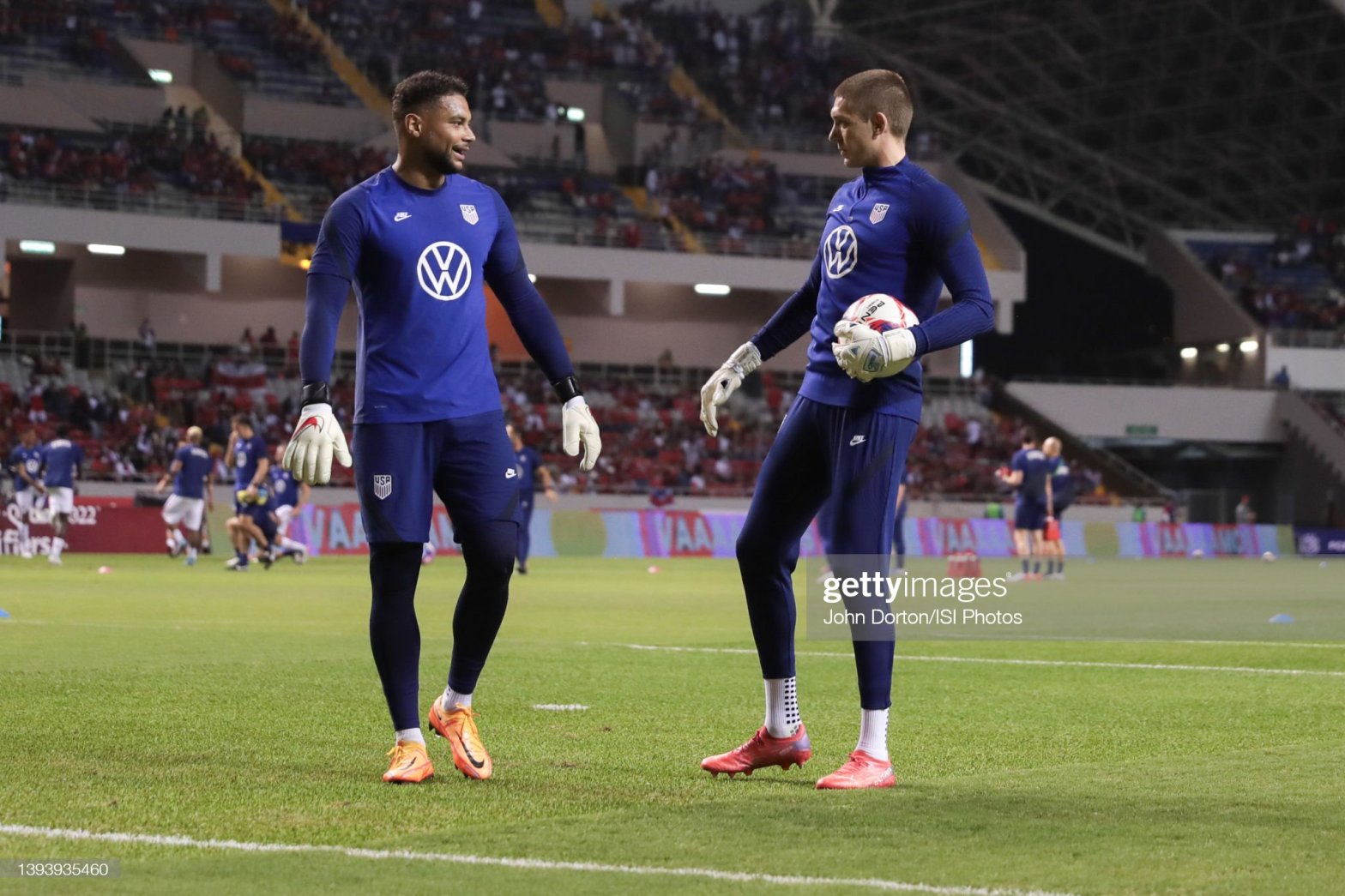
Flash-forward to today and the situation is–complicated. There is no longer a first-choice, clear-cut contender to be the starting goalkeeper in Qatar for the 2022 World Cup. Instead, there is a group of contenders, each with their own pros and cons. While most of the attention is going towards the USMNT’s lack of a clear-cut #9, this problem between the pipes is just as bad–if not even worse.
Let’s take a look at the different options and their current situations, starting from the better/more-likely options and going down.
Zack Steffen
After the disaster of the last World Cup Qualifying cycle, most of the “old breed” of players left the program. One of the biggest names in this contingent was Tim Howard, the longtime goalkeeping stalwart of the USMNT. Once he departed, there was a power vacuum at that position.
So most people looked at Zack Steffen, a young goalkeeper making waves for Columbus Crew SC in MLS. He was 23 years old at the time, starting on a consistent basis. At the end of 2018, he agreed to a move to Manchester City that was finalized in July of the next year. He was immediately loaned to Fortuna Dusseldorf in the German Bundesliga. There, he made 18 starts, most of which came early in the season before he was bogged down with injuries. He couldn’t return for the end of the season, Dusseldorf were relegated and he had no choice but to return to Manchester City.
He has been there ever since, signing a new contract to keep him there for a while. The only problem is that he is a backup, playing behind one of the best goalkeepers in the Premier League: Ederson Moraes. Steffen has mostly been on the bench, only getting the occasional start in the UEFA Champions League and the FA Cup. Most recently, he had a dreadful game against Liverpool in the FA Cup Semi-Final. It was not a good night for him as Manchester City lost 3-2.
For his country, Steffen has featured 29 times, most recently in the final game of World Cup Qualifying against Costa Rica. The US lost that game 2-0, as Steffen was responsible for both goals. It was a microcosm of his qualifying cycle, one in which was less than ideal for the de facto primary goalkeeper. He split the load with fellow ‘keeper Matt Turner (more on him later), starting six of the 14 games. His numbers were–not that good. Combine these numbers with his recent performance for Man City and you have a bad situation. While you could argue that being on an elite team must be doing wonders on Steffen, the lack of consistent playing time is worrying and it shows.
Unless he can secure a loan before the start of the World Cup and get some consistent playing time, I wouldn’t automatically place him as the #1 goalkeeper. There are rumors that he has started to look for a loan so let’s hope he can make it happen.
Matt Turner
It was a qualifying tournament to remember for the New England Revolution goalkeeper, who played quite well and contributed to the USMNT’s success. Matt Turner has been making a name for himself in MLS, going so far as to winning Goalkeeper of the Year and the Supporter’s Shield in 2021. He is 27 years old and has been with the Revolution since 2018, making 107 appearances so far.
His consistent playing time for both club and country has shot him up the playing pool, causing many people to prefer him over Steffen. In addition to doing well in World Cup Qualifying, he played an important role in the USMNT’s Gold Cup-winning campaign last year–including a shutout against Mexico in the final.
Having recently returned from an injury with a shutout against Inter Miami CF, things seem to be going up for Turner. However, there is some room for concern when it comes to his role with the national team. Back in February of this year, he signed a deal with Premier League club Arsenal for $6 million. The deal keeps Turner in MLS until the summer, at which point he will move to England. While this may be a dream move for him (he is an Arsenal fan himself), it does not bode well for his national team career. Young Aaron Ramsdale is currently the Gunners’ primary goalkeeper with Bernd Leno as his backup. Even if Leno is sold, there is a good chance that Turner will just take his place as Ramsdale’s backup. That would leave the USMNT with their #1 and #2 goalkeepers sitting on the bench at their respective clubs.
It’s not an ideal situation for the USMNT, who will be looking to make an impression in their first World Cup since 2014.
Ethan Horvath
It’s difficult to pin Ethan Horvath in a certain spot on the USMNT’s depth chart. At just 26 years old, he’s still a relatively young player. However, he already has experience around Europe and while playing for the national team. He currently plays for Nottingham Forest in the Championship, England’s second-tier division. This is his first season there after four years and 64 appearances for Club Brugge in Belgium’s first division.
Even though he started for Club Brugge in both domestic league and UEFA Champions League games, his role has been relegated to backup for Nottingham Forest. From late February to mid-March of this year, he started a stretch of five games while their primary goalkeeper, Brice Samba, was injured. He only allowed two goals in that stretch and Nottingham were 3-2-0. Since then, however, he has only started one more game: an FA Cup Quarterfinal game against Liverpool that they lost 1-0.
For the USMNT, he has only faired slightly better–mostly because of the players in front of him. Since 2016, he has only made seven appearances, playing in neither the 2021 Gold Cup nor the 2022 World Cup Qualifying. In fact, his last appearance came in June of last year in the Nations League Final against Mexico. Steffen started the match but came off with an injury in the 69th minute. At that point, Horvath had no choice but to come on. The game ended up going to extra time where Christian Pulisic scored a clutch penalty that gave the U.S. a 3-2 lead. However, in the 124th minute, Horvath won the game by saving a penalty shot from Andres Guardado.
While Horvath may seem like the most natural option behind Steffen and Turner, his lack of playing time is also concerning. Even though he has performed well when he has played, there is no consistency–putting him the same boat as those ahead of him. Things could change if Nottingham Forest are promoted to the Premier League (they are currently in the promotion playoffs) but only time will tell if that would help or harm Horvath.
Sean Johnson
Behind Steffen, Turner and Horvath is where it gets murkier. There are a number of different options but none of them are ideal. Let’s start with Sean Johnson, the 32-year-old who currently plays for New York City in MLS. He has been there since 2016, making 177 appearances for them and helping them win MLS Cup last year.
For his country, he has only made nine appearances–his last one coming in February of 2020 in a friendly against Costa Rica. Since then, he has mostly been a bench player and veteran presence, winning the Gold Cup last year without having played a game. So, even though he hasn’t featured much for the USMNT, he still has familiarity with head coach Gregg Berhalter’s system and how he wants to play. However, while he has played well for club, his lack of playing time for country makes it difficult to name him as a replacement.
Brad Guzan
Brad Guzan would normally be higher up in the pool, but his recent injury knocks him off a couple pegs. Back in mid-April of this year, he ruptured an Achilles tendon. Even though he had a successful surgery not long after, he was still placed on the injured list by Atlanta United and is out for the season.
Considering this year’s World Cup starts in November, there is a slight chance that Guzan could return in time for the tournament. However, given his age, I would’t try to rush him back and risk another injury. At 37 years old and with 64 appearances for the USMNT, he is certainly the most experienced in the pool. However, he might be nearing the end of his career at this point.
Gabriel Slonina
At just 18 years old, Gabriel Slonina (possibly) represents the future of the USMNT. He currently plays for the Chicago Fire in MLS and has won the starting role. He is tied for first in the league with five clean sheets so far and is already gaining interest from abroad.
There is just one problem, though; “Gaga” might not end up on the USMNT anyway. After a photo of Slonina went viral on Twitter, reports were confirmed that he has accepted a call-up to the Polish National Team for their upcoming Nations League matches. Even though his “priority is to stay with USMNT,” anything can change. If Slonina likes his time with Poland and sees a better path forward for himself, he may commit to them. However, if he’d rather be part of the USMNT’s bright future, he may decide to just stay with the U.S. Regardless of what he decides, it is a little worrying that Poland is trying to recruit him. As one of five goalkeepers on that Polish roster, it’s hard to see him get any playing time. Even if he doesn’t, he’ll surely be building relationships with the other players and least getting a feel for their style.
In any case, Slonina is still extremely young. Despite his consistent playing time for the Chicago Fire, it’s hard to imagine him being the USMNT’s starting goalkeeper for the World Cup later this year.
Alternative Options
Bill Hamid: Hamid is 31 years old, making him a veteran out of this group of players. He has spent most of his career so far in MLS with D.C. United, aside from brief stint in Denmark with Midtjylland in 2018. With eight appearances for the USMNT he does have some experience there but his aspirations might be elsewhere. Back in March, he was called up by Sierra Leone for a trio of friendly matches. Even though he’s ineligible to switch federations at this point (he played in the 2017 Gold Cup), it’s still telling to see that he would accept such a call-up.
Stefan Frei: Now this is an interesting pick. Frei, the goalkeeping stalwart for the Seattle Sounders, was actually born in Switzerland before moving to the U.S. However, having spent all of his professional career in MLS so far, it seems as if his allegiance lies with the Stars and Stripes. In fact, he became a U.S. citizen back in 2017–paving the way to be a part of the USMNT. However, after being called up to a USMNT camp earlier that year, he has not been called up since. Even though he is 36 years old, he has been a huge part in the Sounders’ success and is consistently starting for them. While it would certainly be a stretch to call him up, I like the idea of having him as an option.
J.T. Marcinkowski: This one is also a long shot but it’s worth the mention. Marcinkowski, 25, is the starting goalkeeper for the U-23 Men’s National Team–a team of players under 23 years old with the exception of three players. Marcinkowski has spent his whole career with the San Jose Earthquakes, signing as a Homegrown Player before being loaned out to Reno 1868 FC and then becoming the starter for the Earthquakes. He has made 61 appearances for them so far, doing a decent job of shoring up the team’s mediocre defense. Even though a better team would probably help him upgrade to a new level, he is still getting consistent playing time.
Who Makes the Cut?
I think Turner should be the starting goalkeeper for the USMNT in November. Even though his move to Arsenal could damage his playing time, he has played consistently for the New England Revolution over the past couple of years–while Steffen has not. Additionally, it was Turner who, for the most part, helped the U.S. qualify for the World Cup. If anything, his actions should be rewarded with a starting position.
Steffen should be Turner’s backup but what about the third-choice goalkeeper? It is rare that this player ever sees action so I think the U.S. has a couple of options. Do you bring Horvath? Johnson out of respect? Slonina to further convince him to stay with the Stars and Stripes? My heart says Slonina. It’s important to always build towards the future and I think bringing him along would go a long way. It would show him how much he means to the USMNT and it would help him build relationships with other players.
In the end, however, this is all still up in the air. Anything can happen over the next six months and these players’ situations can change in an instant. Berhalter has a lot on his plate heading into his first World Cup–hopefully he can plug up this problem in between the pipes.
 Four Score Soccer
One thought on “Pressure Between the Pipes: The USMNT’s Problem Heading Into Qatar”